
Office, Warehouse & Yard Signage Checklist: Safety Signs, Direction Boards, Forklift Routes, Loading Dock Signs & Emergency Exit Signage
sanjeev.rai@darksalmon-ram-449863.hostingersite.com2026-07-02T02:18:12+05:30On This Page
⚡ Key Takeaways
- IS 9457:2005 is the Bureau of Indian Standards governing code for safety colours and signs in every Indian workplace.
- Signage failures cause audit rejections and near-miss incidents — not just an aesthetic gap.
- Office, warehouse and yard each need a separate checklist. One sign list does not cover all three zones.
- Floor markings and wall signs work as a system. One without the other leaves gaps auditors will find.
- Bilingual + pictogram signs are essential. English-only signs reach roughly 40% of the warehouse floor.
- Cast vinyl or 3M-grade materials last 5–7 years outdoors. Economy vinyl lasts 12–18 months.
Most warehouses spend lakhs on racking systems, forklifts, floor scrubbers and fire suppression equipment. The signage discussion comes up during a client audit, an insurance inspection or, worst of all, a near-miss incident involving a forklift and a pedestrian who had no idea which lane was safe to walk in.
LorryZone has installed signage across offices, warehouses, factories and logistics yards in 86+ cities pan-India. This is the complete checklist facility managers, warehouse heads and builders ask us for before every fitout.

Why Signage Is Not Decoration
Signage in a warehouse serves four operational jobs that have nothing to do with aesthetics.
Safety. Forklifts and pedestrians in the same space without clear lane markings and warning signs is an accident waiting to happen. The National Safety Council of India consistently lists equipment-related and slip-trip incidents among the top causes of workplace injuries in industrial settings.
Audit readiness. IS 9457:2005 — published by the Bureau of Indian Standards — is the governing standard for safety colours and signs in Indian workplaces. Missing or incorrectly placed signs are among the most common reasons facilities fail first-pass audits.
Operational speed. A new employee, a visiting driver or a temporary staff member should navigate your facility with zero guidance from anyone on staff. If they need someone to show them where the loading dock is or which area is restricted — your signage is not working.
Professional impression. A branded, well-signed facility signals to clients and auditors that operations are managed. It is a visible proxy for how everything else is run.
Office Signage Checklist
Office signage covers front-of-house and administrative areas. These signs manage visitor flow, identity and compliance.
Identity and Direction
- Reception / company name sign at entrance — backlit ACP or acrylic preferred
- Department boards (HR, Finance, Operations, IT) at each section
- Cabin name plates for managers and executives
- Conference room signs with availability indicators
- Washroom direction boards with gender indicators
- Pantry / cafeteria direction sign
- Lift direction and floor directory boards
Safety and Compliance
- Fire exit signs on every escape route — photoluminescent glow-in-dark for power-cut visibility
- Emergency exit route map on every floor — framed and glass-faced
- First aid room sign with red cross
- Fire extinguisher signs above every extinguisher
- Electrical room / DG room / server room caution signs (restricted access)
- No smoking signs in compliance zones
- Assembly point sign visible from all directions
Operational
- Visitor registration notice at security desk
- CCTV surveillance notice (legally required if cameras are installed)
- Entry / visitor pass instructions board

Warehouse Signage Checklist
This is where compliance and safety converge most directly. Warehouses mix powered industrial vehicles with pedestrian workers — a combination that demands clear, unambiguous signage at every point of potential conflict.
Traffic and Movement
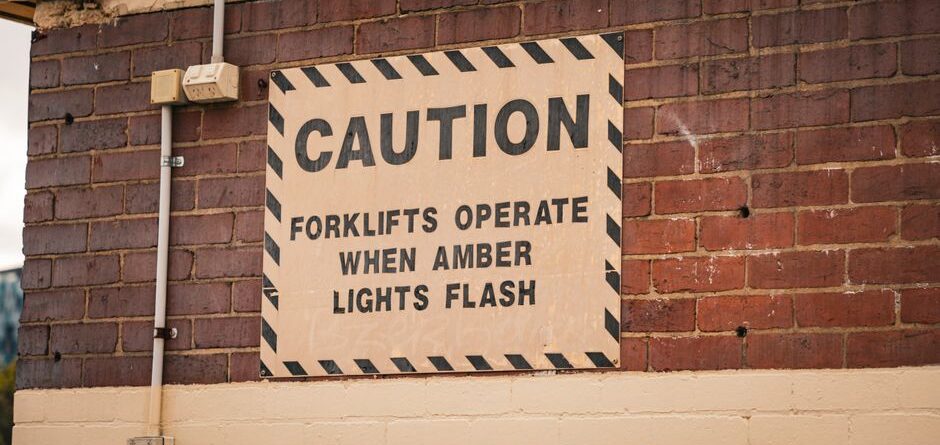
- Forklift movement route signs at every aisle entry point
- Pedestrian walkway signs marking the safe walking corridor
- Speed limit signs for forklifts and vehicles — typically 5–10 km/h inside
- Blind corner warning signs where sight lines are obstructed
- One-way traffic direction boards for main aisles
Access Control
- Authorised personnel only — for restricted zones
- PPE mandatory zone signs at warehouse entry — helmet, safety shoes, hi-viz vest
- No entry for unauthorised visitors
Storage and Rack Safety
- Rack load capacity signs on every bay (maximum load in kg)
- Hazardous material storage zone signs with GHS symbols where applicable
- Battery charging station warning signs
- Cold storage / temperature zone signs if applicable
Emergency
- Emergency exit signs on every route — minimum two exits for warehouses above 500 sq m
- Fire extinguisher type indicator signs (ABC, CO2 — what class of fire each handles)
- Emergency stop signs near automated equipment
- Muster point / assembly point sign visible from the warehouse floor
- No smoking / no open flame signs near fuel or chemical storage

Yard Signage Checklist
The yard is the most neglected signage zone in most facilities. External drivers, contractors and visitors enter here with no familiarity with your layout, protocols or blind spots.
Entry and Access
- Main entrance / facility name sign — large format, illuminated for 24-hour operations
- Security check-in instructions at the gate
- Visitor and driver reporting instructions board
- Authorised vehicles only notice
Loading and Unloading
- Loading bay numbering boards — large, legible from distance and visible at night
- Driver waiting area sign
- Loading dock instruction board (back-in procedure, chock placement)
- Weighbridge direction and instruction sign
- Reverse parking warning / spotter required sign
- Do not enter while truck is docking sign at dock doors
Traffic Flow and Safety
- Speed limit signs at entry and throughout the yard — typically 10–15 km/h
- Entry and exit direction boards — separated clearly if different gates are used
- Truck and HCV parking zone signs; light vehicle parking zone signs
- Pedestrian crossing signs and marked crossings
- Speed bump warning signs ahead of each bump
- PPE required sign at yard entry
- Emergency exit and muster point signs for yard workers

Floor Marking and Signage Work Together
Signs tell people where to go. Floor markings define the boundaries they should stay within. Neither works properly without the other.
In warehouses where forklifts and pedestrians share space, the standard practice is:
- Yellow lines — forklift operating zones and vehicle lanes
- White or green lines — pedestrian walkway boundaries
- Red hatching — restricted zones, emergency equipment clearance areas
- Blue zones — PPE mandatory areas
Loading dock edges should be marked with high-contrast striped tape or floor paint. A warehouse traffic management report notes facilities using both systems see significantly fewer near-miss incidents. Blaxtair’s forklift safety research confirms clear lane demarcation is among the most effective interventions.
Floor markings fade faster than wall signs and need an annual inspection and touch-up cycle. Signs that refer to markings that no longer exist are a specific audit failure point.
Common Signage Mistakes
These are the mistakes we see in almost every facility that calls us after a near-miss or a failed audit.
- Too small. Warehouse signs should be legible from a minimum of 5–10 metres. A sign readable at 1 metre is useless on a busy floor.
- Wrong height. Signs placed below 1.5 metres get obscured by pallets, equipment and parked vehicles. Eye-level or above is the standard.
- Hidden by racking. Install signs on rack uprights or overhead hanging boards — not on walls that will be blocked once racks are loaded.
- Non-reflective yard signs. Reflective vinyl sheeting is non-negotiable for outdoor signs. Non-reflective boards are invisible after dark.
- Faded vinyl. Cast vinyl or 3M-grade materials last 5–7 years outdoors. Economy vinyl lasts 12–18 months.
- No bilingual signage. English-only signs reach roughly 40% of workers on an Indian warehouse floor. Hindi + regional language + pictograms is the correct approach.
- Sign clutter. Five signs at one junction means none get read. Prioritise and give each critical sign space to command attention.
- No maintenance schedule. Faded, damaged or fallen signs signal to auditors that safety is not actively managed.

Best Materials for Warehouse and Yard Signage
Material selection determines how long a sign lasts and what it costs over a five-year cycle — not just at installation.
| Application | Recommended Material | Why |
|---|---|---|
| Office indoor signs | Acrylic, ACP | Clean finish, durable, professional look |
| Warehouse wall signs | Sunboard, ACP, aluminium | Lightweight, easy to mount, chemical resistant |
| Emergency exit signs | Photoluminescent (glow-in-dark) | Visible in power cuts, compliant with fire codes |
| Yard entry / name signs | ACP with MS frame | Rigid, weather-resistant, large format capable |
| Yard speed / direction | Reflective vinyl on aluminium | Visible at night, withstands outdoor conditions |
| Floor markings | Epoxy paint, thermoplastic, anti-skid tape | Durable under forklift traffic |
| Loading dock | High-contrast reflective tape + markings | High-wear area, visible in all conditions |
| Hazmat zones | UV-rated vinyl with GHS symbols | Chemical-resistant, internationally recognised |
LorryZone fabricates in-house across all these categories. Sign dimensions, materials and bilingual text are confirmed before production — not adjusted on-site during installation.
Frequently Asked Questions
IS 9457:2005 is the Bureau of Indian Standards code of practice for safety colours and safety signs in Indian workplaces, covering accident prevention, fire protection, health hazards and emergency evacuation. It applies to all commercial and industrial premises including warehouses, factories and offices. Signs must follow prescribed colour codes — red for prohibition, yellow for caution, green for safe condition, blue for mandatory action. Source: IS 9457:2005 via Law Resource India.
Every exit route must be signed — one sign at each exit door plus directional arrows at every point where the route changes direction. Warehouses above 500 sq m should have a minimum of two clearly marked exit routes. Emergency exit signs must use photoluminescent material so they remain visible when power fails — this is inspected during fire NOC renewals.
IS 9457:2005 mandates warning signs wherever a hazard exists — and a working forklift in a shared space qualifies. Best-practice facilities include: forklift operating zone boards, pedestrian walkway signs, speed limit boards, blind corner warnings and PPE mandatory signs at warehouse entries. Brady India’s forklift and warehouse sign range aligns with both IS and ISO colour coding.
Warning signs (yellow background, black border and symbol) alert to a hazard. Prohibition signs (white background, red circle with diagonal bar) forbid a specific action. Mandatory signs (blue background, white symbol) require a specific action — such as wearing PPE. Using the wrong sign type is a common compliance failure that auditors flag.
IS 9457 governs mounted and wall signs. Floor markings fall under separate paint and factory safety standards. In practice, fire inspectors and safety auditors treat floor markings and wall signs as a single safety system. Missing floor markings in pedestrian-vehicle shared zones are flagged as safety risks regardless of which specific standard is cited.
Conclusion
An office, warehouse or yard that scores well on signage almost always scores well on safety, audit readiness and operational professionalism. These are not separate outcomes — they come from the same discipline.
The checklist above covers the minimum for each zone. What sits behind it is a single rule: every person entering your facility — employee, driver, visitor, inspector — should be able to navigate it safely and independently within three seconds of arriving at any junction.
If that is not true for your facility today, the gap is identifiable and fixable. A signage audit takes two to three hours. The signs themselves, once correctly specified, are fabricated and installed in days.
One Thing to Check Before You Call Anyone
Stand at the main pedestrian entry to your warehouse floor. Count how many seconds it takes to identify: where you should walk, where forklifts move, and where the nearest emergency exit is.
If the answer is more than three seconds — or if you cannot find all three from that single point — your signage system has a gap. That gap is what a client auditor or fire inspector will find first.
A signage audit takes two to three hours for a standard 10,000 sq ft warehouse. It identifies every missing, damaged, non-compliant or wrongly placed sign before an external auditor does.
Next Step
LorryZone conducts signage audits and handles supply, fabrication and installation across offices, warehouses, factories and yards in 86+ cities pan-India.
If you are setting up a new facility, preparing for a client audit or replacing faded signage, the starting point is a site visit or a floor plan review.
Get a signage audit for your facility — share your floor plan or location at lorryzone.com/contact and our team responds within 24 hours.

About the Author
Sanjeev Rai
Co-Founder, LorryZone
Sanjeev is the co-founder of LorryZone, a multi-domain branding and industrial execution company serving India’s logistics, mobility, warehousing, and corporate infrastructure sectors. Over the years, he has built experience across advertising, media, vehicle painting, warehouse painting, signage, interior solutions, and business technology. His work focuses on combining ground-level execution with digital systems — helping companies improve brand visibility, operational safety, and service consistency across vehicles, warehouses, yards, and commercial spaces.

Leave a Reply